
When someone you love passes away, the legal process that follows is often the last thing on your mind. Families are grieving, supporting one another, and trying to make practical decisions during an emotional time. For many Texas families, probate becomes a necessary step in settling an estate.
If you have never been through probate before, it can feel unfamiliar and overwhelming. The good news is that Texas offers a relatively streamlined probate system compared to many other states. Once you understand the structure, the timeline, and your responsibilities, the process becomes far more manageable. This article explains how probate works in Texas and what families in Dallas and surrounding communities should realistically expect.
What Probate Means In Texas
Probate is the court-supervised process of transferring a deceased person’s assets, resolving debts, and ensuring property passes to the correct beneficiaries. If the person left a valid will, the court confirms it and appoints the named executor. If there is no will, the court appoints an administrator and applies Texas intestacy laws to determine who inherits.
In Texas, probate typically involves:
- Admitting the will to probate, if one exists
- Appointing an executor or administrator
- Identifying and valuing estate assets
- Classifying debts in order of priority
- Notifying and paying creditors
- Distributing remaining property to beneficiaries
It is important to understand that not all assets go through probate. Life insurance policies with named beneficiaries, retirement accounts with beneficiary designations, and certain jointly owned property may pass outside of probate. A careful review of how each asset is titled is one of the first steps in evaluating what the court process will involve.
When Probate Is Required
Probate is generally required when someone dies owning assets solely in their name, without beneficiary designations. For example, a home titled only in the decedent’s name or a bank account without a payable on death designation will usually require probate before ownership can be transferred.
Under Texas law, a will generally must be admitted to probate within four years of the date of death. After that period, options may become more limited. In some situations, probate as a muniment of title may still be available if the applicant was not in default, but families should not assume that delay will have no consequences.
Acting promptly helps preserve options and reduces the risk of complications.
Types Of Probate Proceedings In Texas
Texas probate law provides several different procedures depending on the circumstances of the estate.
Independent Administration
This is the most common form of probate in Texas. It is “independent” because, after appointment, the executor operates with minimal ongoing court supervision. Independent administration is often faster and more cost-effective. Many properly drafted wills specifically authorize this form of administration.
Dependent Administration
In this process, it is described as “dependent” because the administrator must seek court approval before taking the most important actions, such as selling property or paying claims. This type of administration involves closer oversight and can take longer to complete. It is more common when disputes exist or when a will does not authorize independent administration.
Muniment Of Title
When there is a valid will and no unpaid debts other than secured debt such as a mortgage, a more simplified probate process called a “muniment of title” may be available. This allows the will to function as evidence of ownership transfer without full administration. It is a streamlined option but only applies in limited circumstances.
Small Estate Affidavit
For smaller estates with no will and assets below statutory limits, Texas law allows the use of a small estate affidavit. Strict eligibility requirements apply, and this procedure is not available in every situation.
Determination Of Heirship
When someone dies without a will and administration is necessary, the court may conduct a proceeding to formally determine the legal heirs under Texas law. Community property rules can significantly affect how property is divided in these cases.
Choosing the correct probate pathway is one of the most important early decisions in the process.
The Step-By-Step Probate Process
Although each estate is unique, most probate cases in Texas follow a general sequence.
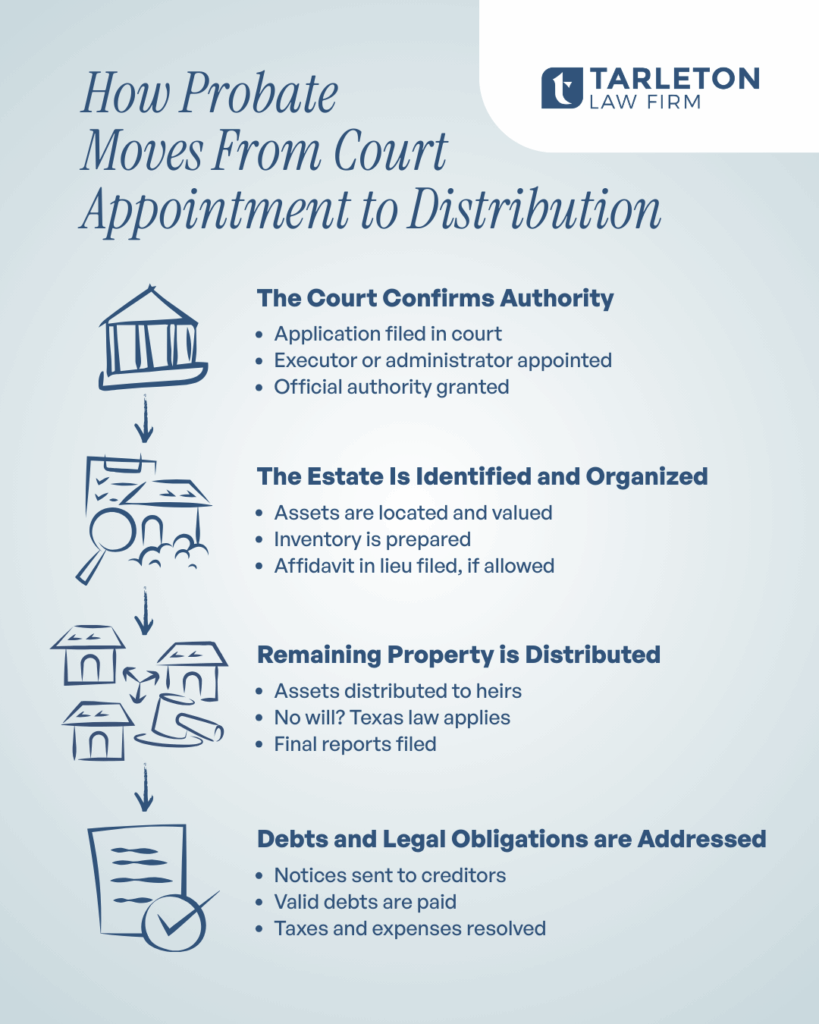
1. Filing The Application
The process begins by filing an application in the probate court of the county where the decedent resided. In Dallas and surrounding counties, this is typically handled by the county probate court.
2. Court Hearing
After filing, the court schedules a hearing to determine whether the will is valid and whether the proposed executor is qualified. If approved, the court formally appoints the executor or administrator.
3. Letters Testamentary Or Letters Of Administration
Once appointed, the executor receives official documents that grant authority to act on behalf of the estate. Financial institutions, title companies, and other third parties usually require these letters before releasing funds or transferring property.
4. Inventory, Appraisement, And List Of Claims
Within 90 days of qualification, unless the court grants an extension, the executor must file an inventory, appraisement, and list of claims.
In some independent administrations, instead of filing a detailed inventory with the court, the executor may be allowed to file what is called an affidavit in lieu of inventory. This is only permitted if certain legal requirements are met, including confirming that beneficiaries have already received a complete and verified list of the estate’s assets and that there are no unpaid debts other than secured debts (such as a mortgage), taxes, and administration expenses (like attorney fees). In those cases, the court does not require the full inventory to be made part of the public record, which helps preserve privacy over the Estate assets and what beneficiaries receive.
Careful preparation of this document is critical. Incomplete or inaccurate inventories can delay administration and create unnecessary risk.
5. Notice To Creditors
Texas law requires specific notice to certain known creditors and publication notice to unknown creditors. Secured creditors and unsecured creditors are treated differently under the Estates Code. The executor must evaluate claims and determine whether they are valid before paying them.
6. Paying Debts And Taxes
Before distributing property to beneficiaries, the executor must ensure legitimate debts and taxes are paid. This may include final medical expenses, credit obligations, funeral expenses, and administrative costs.
7. Distribution Of Assets
After debts are resolved, the executor distributes remaining assets according to the will or, if no will exists, according to Texas intestacy law.
8. Closing The Estate
In independent administrations, a formal closing is not always required. However, the executor may file a closing affidavit or report once duties are complete. Regardless of the formality involved, the executor continues to owe fiduciary duties throughout the process.
How Long Probate Takes In Texas
Families often want a clear timeline. While every estate is different, many straightforward independent administrations may take six months or longer. The exact length depends on factors such as creditor notice periods, asset complexity, court scheduling, and whether disputes arise.
More complex estates, dependent administrations, or contested matters can extend the timeline significantly.
There are statutory waiting periods built into the probate process, including creditor notice requirements. Even when all parties agree, these timelines must be respected.
Also read: How Long Does Probate Take in Texas? Timelines for Terrell and Dallas Estates
What Families Can Do To Make Probate Smoother
If you are facing probate in Texas, there are several concrete steps that can make the process smoother.
- Locate the original will and any trust documents promptly. Courts generally require the original document.
- Secure real property and valuable personal property. Protecting estate assets is part of the executor’s responsibility.
- Create a preliminary list of assets and liabilities; even a general outline will help your attorney assess the situation efficiently.
- Avoid distributing property before the appointment; even if everyone agrees informally, the executor must have proper authority before transferring assets.
- Keep detailed financial records. Maintain documentation of every expense paid, every notice sent, and every distribution made.
Can Probate Be Minimized Or Avoided
Many families ask whether probate can be avoided altogether. Tools such as revocable living trusts, transfer on death deeds, and beneficiary designations can reduce the assets that pass through probate.
However, these tools must be properly implemented. A trust that is not funded will not avoid probate. Beneficiary designations must be current and coordinated with the broader estate plan.
For families who have not yet faced probate, proactive estate planning often makes administration significantly easier.
Final Thoughts
Probate in Texas is a structured legal process designed to ensure that property is transferred correctly and debts are handled responsibly. While it involves court filings and statutory requirements, it does not have to be chaotic or adversarial.
Understanding what to expect helps families move forward with greater confidence. With careful organization, timely action, and experienced legal guidance, probate can proceed in an orderly and efficient manner.
If you are navigating probate in Dallas or surrounding communities, Tarleton Law Firm is here to support you through the journey. We understand the Texas Estates Code, the local courts, and the realities families face during administration.
If you’re in need of probate guidance, book a consultation with us.
Whether you are serving as an executor or trying to understand your rights as a beneficiary, our team is here for you.
Common Questions
How long does probate take in Texas?
Texas independent administration (the standard process when a properly drafted will exists) typically takes 6 to 12 months from filing to closing. Dependent administration (without a will or with court-supervised probate) typically takes 12 to 24 months. Muniment of title (a streamlined option when the estate owes no unpaid debts other than debts secured by real estate, such as a mortgage) is usually the fastest route because it typically takes a single court hearing, with timing set by the county court’s schedule.
What are the steps in Texas probate?
Texas probate involves (1) filing the will and application with the probate court in the county of residence, (2) attending a hearing where the will is admitted, (3) appointing the executor, who posts an Oath, (4) publishing notice to creditors, (5) filing an Inventory, Appraisement, and List of Claims within 90 days, (6) paying valid debts and taxes, and (7) distributing remaining assets to beneficiaries and closing the estate.
How much does probate cost in Texas?
Texas probate court costs typically run $300 to $500 for filing fees plus publication. Attorney fees for independent administration of a straightforward estate generally range $2,500 to $7,500. Dependent administration and contested probates can run significantly higher because of mandatory court oversight at each step. Most Texas wills are drafted to qualify for independent administration to keep costs down.
About the Author
Allan Tarleton is the founding attorney of Tarleton Firm, a Texas estate planning and probate law firm with offices in Dallas and Terrell. Allan is Board Certified in Estate Planning and Probate Law by the Texas Board of Legal Specialization, a distinction held by fewer than 1% of Texas attorneys. He has over 16 years of experience guiding Texas families and business owners through estate plans, wills, trusts, probate administration, and business succession planning.